Some of the leading manufacturing companies in Nelson Mandela Bay are pursuing innovative water-saving systems to improve the efficiency of their manufacturing operations while reducing their dependency on municipal water supply.
These initiatives form part of their zero water roadmaps and in the past few years, have saved the companies millions of litres of water while also ensuring they meet their targets of reducing their impact on the environment.
Companies such as Volkswagen South Africa, Isuzu Motors South Africa, Aspen Pharmacare, Ford Motor Company, Coca Cola Beverages South Africa and Continental Tyre South Africa are among the largest contributors to alleviating the Metro’s water crisis, as well as some of the largest employers and contributors to social upliftment and economic empowerment in the region. They are the backbone of the manufacturing sector and major drivers of employment creation and economic growth.
The companies have spent millions of rands on their industrial and water consumption measures, an indication of a long-term commitment to saving millions of litres of water for the city and its citizens. For instance, Aspen Pharmacare has invested R60 million in taking its water consumption completely “off-grid”. This has made an additional 1 million litres of water per day available to other consumers in the metro.
VWSA’s Head of Group Communications Andile Dlamini says as part of the company’s water roadmap, it has cut its consumption of municipal water by over 70% since 2010, with water used in production currently standing at approximately 1 000kl per day.
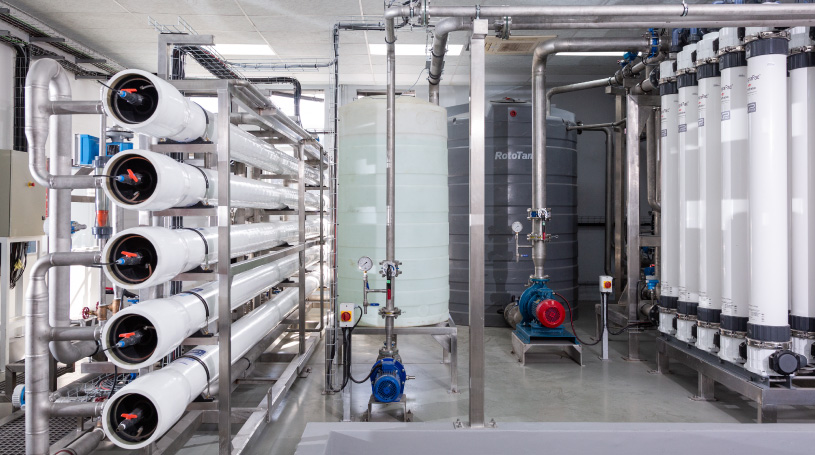
The company further invested R20 million in a wastewater recycling facility in 2022, which currently recycles 150 kl of wastewater per day and is being ramped up to 250 kl per day. This will allow over 70% of all wastewater to be recycled and reused, resulting in a 26% reduction in total fresh water use. A Reverse Osmosis system recycles brine/concentrate water for ablutions and wash bays, saving over 1 100 kl of fresh water per year. The company’s rainwater harvesting system has saved 2 393 kl of fresh water since June 2022, and new installations this year will save an additional 6 000 kl per year.
Ford Motor Company has also deployed an extensive range of water saving measures, which have been introduced at its Struandale Engine Plant. Rainwater is channelled from the plant’s vast roof areas into tanks located throughout the facility, with a combined storage capacity of 155 000 litres. Through a water management system, this harvested water is fed directly into the ablution facilities and used for the flushing of toilets. Furthermore, all of the ablutions have been revamped and fitted with the latest water saving systems that have significantly reduced water usage during flushing and washing.
“Waste management is a crucial element of our day-to-day operations. A wide range of recycling initiatives implemented over the years have resulted in more than 97% of the plant’s waste products being recycled, and our water-saving initiatives have resulted in a significant reduction in our water consumption,” says Shawn Govender, Plant Manager of the Struandale Engine Plant.
Coca Cola Beverages South Africa has also taken numerous steps to reduce water usage and recycle, and reuse water used in its production processes. Water used in bottle cleaning and rinsing is recovered and reused, instead of municipal water, for cooling towers, ablutions and floor washing, while the process itself has been optimised to use less water.
“Optimisation of the on-site reverse osmosis plant has resulted in reduction of wastewater, while the plant also makes use of a borehole and rainwater harvesting. In addition to that, the company implemented nine off-grid groundwater harvesting systems known as Coke Ville in the communities of Walmer Township, Lorraine and Kariega. These systems have a potential of supplying over 90 million litres per annum,” says Nolundi Mzimba, the company’s Regional Public Affairs and Communications Manager.
The battery manufacturing company Auto-X, formerly Willard Batteries, has reduced its municipal water consumption by between 30% and 50%, with a target of becoming a zero-effluent, by recycling all grey water back into the process water system and using waste process water, usually discharged to the sewer system, for flushing toilets.
Isuzu Motors SA has also made huge strides in reducing its municipal water consumption with capacity to harvest 60kl of water from the plant roofs for use in their water-test facility and fire dam, while processed water is harvested and treated on-site with use of greywater for ablutions flushing saving up to 20kl of clean water per day.
The has reduced its water consumption per unit by 71%, from 3.55kl/unit to 1.02 kl/unit within the last five years. It has further invested over R10 million in taking action to reduce its municipal water consumption within the Metro.
“We have installed capacity to harvest 60kl of rainwater from the plant roofs for use in their water-test facility and fire dam, while processed water is harvested and treated on-site with the use of greywater for ablution flushing, saving up to 20kl of clean water per day. Other measures include recycling all process water to top up a number of our processes, cooling towers and replenishing of our fire dam. We have also implemented restrictions on taps effectively limiting the flow of water,” says Sharné Woods, Senior Manager Corporate Communications.
She says the company has also installed six boreholes on its manufacturing site. The water that will come out of the boreholes will be used in the company’s manufacturing processes, including the paintshop and cooling towers. This will supplement the municipal supply while reducing the burden on the city’s water supply.
“As part of the Adopt a School initiative, ISUZU has also adopted six schools in the Metro area to assist with several aspects from refurbishing their facilities and plumbing to reduce water leaks, and ensuring water supply by drilling a borehole at one of the schools.”
Since 2020, Continental Tyre South Africa has achieved a significant reduction in water consumption, with an impressive 35% decrease achieved in just two years. This reduction equates to saving 16,477 kl of water annually, which was achieved through a number of interventions such as repairing water leaks on site, using rainwater harvested for boiler feed water, refurbishing cooling towers to reduce water losses, using dirty condensate for cooling tower top up water, improving clean condensate return from steam generation, as well as steam reduction projects.
The efforts from these companies build on a number of Chamber driven water saving initiatives where member companies are involved. Chamber chief executive Denise van Huyssteen says as a response to the city’s water crisis, the Chamber established an Adopt-A-School initiative which has seen 76 schools across the metro assisted by business to date with repairing of leaks, upgrading plumbing for water efficiency, education on reducing water consumption, and installation of water-saving and harvesting measures including rainwater tanks and boreholes.
“During 2022, when the metro’s supply dams reached critically low levels and the prospect of dry taps was real, the Chamber initiated the Adopt-a-Leak project to address the metro’s high rate of water losses due to leaks. The project, funded and led by Aspen Pharmacare, Volkswagen SA and Continental Tyres; focused on addressing household leaks in seven impoverished areas of the metro that had the highest rates of water losses,” says Van Huyssteen.
“The thinking being that leaks on the demand, or customer side, of the system account for a large proportion of water losses, and that residents in the identified “hotspot” areas generally do not have the financial resources or skills to do plumbing repairs. Over a period of six months, more than 4 200 households were assisted, resulting in a 23% reduction in water demand in these areas – saving over 1.5 million litres per day of the metro’s treated water from going literally down the drain.”
CONTACT US
Association of South African Chambers
info@asac.org.za