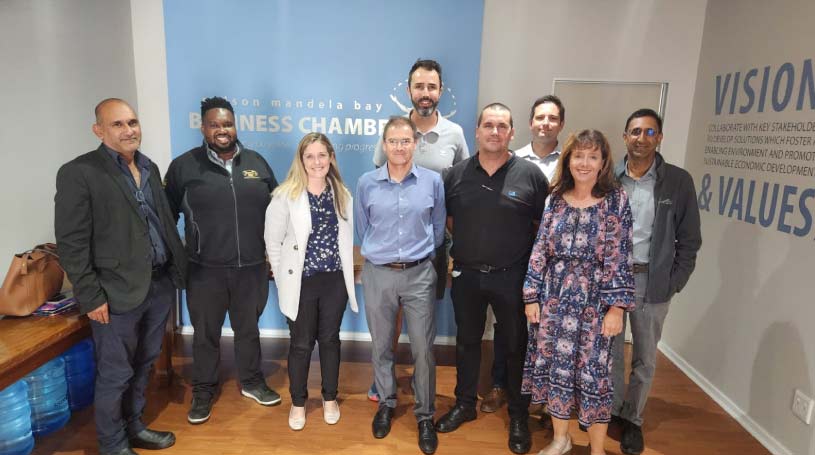
A group of businesses which operate in the Neave/Korsten area in Nelson Mandela Bay have established a business Cluster, under the banner of the Nelson Mandela Bay Business Chamber. This is now the sixth geographical cluster to be established by the Chamber for the purpose of enabling businesses to work together to address common issues which impact upon their operating environment.
The establishment of the cluster is set to facilitate a more efficient and collaborative approach between businesses in the respective areas to find solutions to key issues which impede the running of their operations. Over the past year, the Chamber has facilitated the establishment of the Perseverance, Deal Party, Kariega, North End and Struandale clusters, which have developed action-orientated strategies that respond to common challenges such as safety and security, illegal dumping and cleanliness.
The clustering approach is an initiative of the Nelson Mandela Bay Business Chamber, which over the last year has facilitated the establishment of various sectoral and geographical clusters geared towards representing the needs and interests of business, with the primary focus of retaining much needed investment and jobs in Nelson Mandela Bay.
Chamber chief executive Denise van Huyssteen commended the team for implementing this initiative as it perfectly aligns with the Chamber’s strategy of collaborating as a collective to resurge the metro’s economy through an activist and action-orientated approach. “It is not about finger-pointing but rather about getting a common understanding of the issues and then working with key stakeholders who are committed to taking constructive actions which are in the best interests of the local economy.”
Earlier this year a memorandum of understanding was signed between the Business Chamber and the Nelson Mandela Bay Municipality, which paves the way for businesses to partner with the metro to implement solutions in response to the multiple challenges in the operating environment. The geographical clusters, with their collective resources, are well positioned to drive action and to achieve positive impact, which has a knock-on benefit in their immediate surrounding areas.
“A great example of this is the Adopt A Sub-Station intervention which has resulted in businesses adopting 19 sub-stations so far, and as such preventing the vandalism and theft of these key infrastructure sites,” she says. “Additionally businesses have adopted 77 schools around the Metro where leaks are being fixed and this is particularly relevant in terms of the current water crisis as 10% of total water losses happens at schools.”
Another benefit of the cluster approach is that it provides a platform for quick information sharing and communication between businesses. “This is particularly important in instances when there are power outages, water disruptions and when safety and security issues occur.”
An interim core group, representing various businesses in the area, have been appointed to determine key priorities of the Neave/Korsten Cluster and to mobilise the participation of additional businesses in the area.
RovD Group Business Development Manager Athi Lupondwana, who is part of the interim committee, says “as a company that moved to Lindsay Road in 1964, we have decided it is time for business to do more and be more in our city.”
Grindstone Property Management and Development Director and Chamber Geographic Cluster Lead Paola Cicognini-Horak says the Neave/Korsten has long been plagued with problems that negatively impact on the local business community.
“These problems such as crime relating to the theft of both public and private infrastructure, illegal dumping and general infrastructure decay are not easily resolvable by individual businesses standing alone,” says Horak. “The old saying goes – ‘the best place to find a helping hand is at the end of your own arm’ – the Neave/Korsten businesses have taken an collaborative decision to link their arms to create a collective hand to address the problems in their area.”